

Trump can’t dump Strait of Hormuz on UK or EU amid ‘strategic amnesia’
The Beacon talks to Commodore Simon Kelly on the Iran Conflict

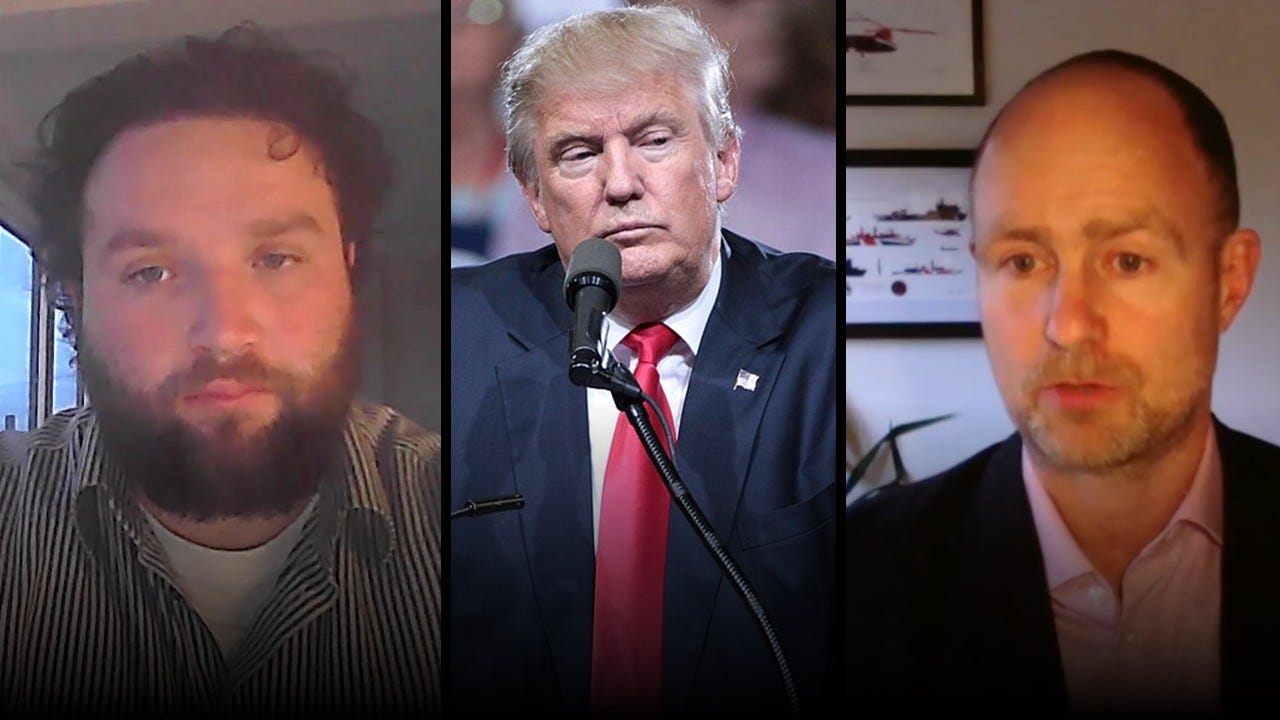
Disclaimer: This Interview was on the 2nd of April, before the announcement of a two-week ceasefire on the 8th.
On February 28, US President Donald Trump, alongside Israeli Prime Minister and ever-closer ally Benjamin Netanyahu, started to bomb Iran “back to the Stone Age”.1
Oil prices rocketed, Iran’s leadership was targeted and Supreme Leader Ayatollah Ali Khamenei was killed.
Since then, Iran pulled one of the only leavers it had and effectively shut down the Strait of Hormuz - a critical waterway that sees nearly 20% of the world’s oil and natural gas supply pass through it.2
“Build up some delayed courage, go to the Strait, and just TAKE IT. You’ll have to start learning how to fight for yourself, the U.S.A won’t be there to help you anymore,” Trump’s Truth Social post, directed at the UK, read on 31 March.3
“They prepared for this.”
Commodore Simon Kelly spent over 27 years in the Royal Navy, with his service career seeing him deploy to the Gulf on numerous occasions and captain a number of ships.4
He also served as the Deputy Commander UK Strike Forces and led the inaugural NATO Combined Task Force (Atlantic).5
Commodore Kelly explained to The Beacon it was “indicative” that we haven’t seen one US ship sail through the Strait since the start of Trump’s war with Iran.
The Strait lies between the Persian Gulf and the Gulf of Oman, with Iran on the north and the UAE, Oman and Qatar lying below it on the south.
While Pete Hegseth, the US Secretary of Defense, and Trump have celebrated the US success against Iran’s conventional navy, it is the Revolutionary Guard Corps that pose a threat in the waterway.
“We’re talking about a really narrow section of water,” Cdre Kelly said.
He explained you can see what ships are travelling through the Strait from the coastline and all it would take is some small fishing vessels or boats to attack.
This is an asymmetric threat, which means the powers are not equal - but this works against the US in this example.
“[The] Iranian Guard Corps… it’s probably been worn down hugely by American action, but it’s huge,” he explained.
“They’re distributed along the coastline and they prepared for this.”
The Feasibility of an Invasion
Cdre Kelly said it is this worst case scenario the Iranians have prepared for and a multi-layered attack is exactly what makes Trump’s claim the UK should just go and “TAKE” the oil so absurd.
“You take the cover off your boat, you push it off that dock… and in a very short space of time, you can get your small boat in close proximity to anything that’s coming through,” he said.
“You’re able to manoeuvre freely, you present an incredibly difficult target because you’re moving, you’re moving fast, you can move erratically.
“There’s no way of going through this low-risk concept that Trump and Hegseth like to throw out there.
“It’s a really, really complicated task.”
This has not stopped the US stacking materiel in the region.
This includes the USS Tripoli, an amphibious readiness group who get troops to an area, and then the 31st Marine Expeditionary Unit and 11th Marine Expeditionary Unit, who would carry out the landing.
USS Boxer is also believed to be heading to the region, as well as 82nd Airborne Division - a rapid parachute infantry division from the US Army.
Alongside all of this, there are also two full US Carrier Strike Groups, with both USS Abraham Lincoln and USS Gerald R. Ford in the region - with USS George H.W. Bush also headed out to replace Ford.
Cdre Kelly said if all that military might is actually there “to do something with”, that comes with a “terrifying bit… of thinking behind that”.
If the capabilities are used to punch US troops ashore, putting US Marine Corps in as pickets in the Strait of Hormuz”, it could leave personnel trapped in the waterway.
The shape, as an inverted ‘V’, has a number of islands that could “conceivably” be used to put a US Marine Corps footprint ashore.
This includes Kharg Island, a fuel hub for Iran which Cddr Kelly said is about 550 kilometres inside the Gulf.
“I suppose the thinking.. is you land the Marines there and you have your hand around the throat of oil supplies back into Iran and that is used as your bargaining chip,” he explained.
“But it’s only about 30 kilometres off the coastline.
This then leaves the personnel fixed, with the Iranians able to “batter them with whatever they’ve got that the US hasn’t been able to destroy”.
Tehran could also mine the Strait behind the ships used to get personnel ashore, making it nearly impossible to get back out.
“There’s this really quite scary situation when there’s a potential for some kind of amphibious assault into one of these areas where they will be protected.
“They will be ready and the IRGC’s mindset is just one of sacrifice and resilience, it’s cultural, it’s religious, it’s historic and so these aren’t people who are going to throw down their weapons and run away.
“The casualty numbers are going to go up and so you then end up with a situation in which the American president and his administration have ordered them in there.
“It’s inevitable that there will be significant losses and so that’s why there’s sort of the military planner in me [who] thinks, well, you can’t conceive of using this lever.”
America’s Scapegoats
Trump has repeatedly chastised European allies for their lack of support in the US and Israel’s war in Iran.6
This included his criticism of Prime Minister Sir Keir Starmer, who he said was looking to “join wars after [the US has] already won”.7
“This is not Winston Churchill that we’re dealing with,” Trump said of the PM.
It came after Sir Keir appeared to not allow the US to launch attacks from UK bases, namely RAF Fairford and Diego Garcia, which is located in the Chagos Islands in the Indian Ocean.
But it is easier to blame someone else rather than take responsibility, Cddr Kelly pointed out, adding it could be a case of “strategic amnesia”.
“I think it’s much easier to blame NATO, they keep on saying NATO,” he said.
“They’re either showing a fundamentalist misunderstanding of what that alliance means or they’re using it conveniently.”
Trump has since also blamed South Korea and Japan for not helping as much as he thinks they should have.
“What they’re doing is if you blame someone else for the situation that you find yourself in, you can go down your off-ramp. and you can very conveniently shift the focus onto someone else.”
“You can say, ‘well, we’ve done what we need to, the Strait of Hormuz is up to someone else.”
“My view would be that it’s much easier to say… ‘the price is going up at the pump in the US is not because of us, it’s because our European partners… aren’t doing what they should do.”
The conflict has since escalated, with Trump claiming he would bomb Iran back to the Stone Age and later asserting “a whole civilisation will die tonight” unless Tehran agreed a deal to reopen the waterway.8
“There’s no winning this,” Cddr Kelly said.
“There’s no win at all for anyone, I think it potentially ends up as being a generational challenge.”
1Trump, Donald. “Truth Social.” Truth Social, 2026, truthsocial.com/@realDonaldTrump/posts/116329512466946656.
2“Strait of Hormuz Is Chokepoint for 20% of World’s Oil - U.S. Energy Information Administration (EIA).” Eia.gov, 2024, www.eia.gov/todayinenergy/detail.php?id=7830.
3Trump, Donald. “Truth Social.” Truth Social, 2026, truthsocial.com/@realdonaldtrump/posts/116323481956698353. Accessed 11 Apr. 2026.
4BIOGRAPHY of COMMANDER SIMON P KELLY ROYAL NAVY. Sept. 2016.
5Ibid
6Jr, Bernd Debusmann, and Claire Keenan. “Trump Criticises Nato as Alliance Chief Mark Rutte Describes Meeting as “Very Frank.”” BBC News, 9 Apr. 2026, www.bbc.co.uk/news/articles/c05d8j9r5ejo.
7Faguy, Ana, and Jack Fenwick. “Trump Accuses Starmer of Seeking to “Join Wars after We’ve Already Won.”” BBC News, 8 Mar. 2026, www.bbc.co.uk/news/articles/c9dn3j04lydo.
8Trump, Donald. “Donald J. Trump (@RealDonaldTrump).” Truth Social, 2026, truthsocial.com/@realDonaldTrump/posts/116363336033995961.